Late to the Party, First to the Loss: The Hidden Danger of Chasing Stocks That Have Already Moved

There is a particular kind of financial pain that does not announce itself loudly. It arrives quietly, disguised as confidence. A stock you have been watching climbs 40 percent in three weeks. Analysts upgrade it. Financial media covers it breathlessly. Your brokerage app sends an alert. And then, at precisely the moment when the evidence feels most overwhelming, you buy — just as the trade finishes working.
This sequence is not coincidence. It is a structural feature of how retail capital flows into markets, and understanding it is essential for anyone who intends to trade with genuine conviction rather than borrowed enthusiasm.
Why the Best-Looking Stocks Are Often the Worst Buys
Momentum, as a factor, is real. Academic research has documented it extensively. Stocks that outperform over a three-to-twelve-month window do, on average, continue to outperform over the following quarter. Institutional quant funds have built entire strategies around this observation, and they execute them with precision — entering early in a trend cycle and exiting before the narrative reaches saturation.
The problem retail investors face is not that momentum does not exist. The problem is timing. By the time a stock appears on a most-active list, dominates financial social media, or earns a segment on cable business news, the institutional phase of accumulation is typically complete. What remains is the distribution phase — the period during which early buyers quietly reduce exposure while late arrivals absorb the supply.
Data from retail trading patterns consistently shows a predictable lag. Retail purchase volume in individual equities tends to spike approximately two to four weeks after a stock's most significant price move. In other words, the average retail investor buys after the move has already happened, not during it. The chart looks compelling precisely because the work is done.
The Cognitive Architecture of a Bad Entry
Understanding why this happens requires stepping back from market mechanics and examining the psychological machinery at work.
Recency bias is the most obvious culprit. The human brain assigns disproportionate weight to recent events, treating a stock's last three weeks of performance as predictive of its next three weeks. When something has risen sharply, it feels safer — not riskier — because the trend appears established. This is the inverse of rational risk assessment, which would recognize that a stock trading at 52-week highs with elevated retail interest and stretched valuations carries substantially more downside risk than the same stock did before anyone was talking about it.
Social proof compounds the problem. When a position is discussed approvingly across investor forums, mentioned in earnings call summaries, and validated by analyst commentary, it triggers a conformity instinct. Buying feels like joining a consensus rather than making a speculative decision. The crowd provides psychological cover even when the crowd is wrong.
Finally, there is FOMO — the fear of missing out — which functions less like a rational calculation and more like an emotional override. The pain of watching a stock continue to rise after you declined to buy it often exceeds, psychologically, the pain of an equivalent loss. This asymmetry in emotional accounting causes investors to take entries they would otherwise reject, simply to eliminate the discomfort of being left behind.
What Exhausted Momentum Actually Looks Like
Distinguishing between a trend that has room to run and one that is quietly rolling over is not a matter of intuition. There are observable signals that, taken together, form a coherent picture of momentum exhaustion.
Volume divergence is among the most reliable. A healthy trend typically shows rising price accompanied by expanding volume. When a stock continues to make new highs on progressively lighter volume, institutional participation is fading. The price is moving, but fewer large players are driving it — a structural warning that the trend lacks underlying support.
Breadth deterioration within a sector tells a similar story. If a handful of high-profile names are still advancing while the broader sector has already peaked and begun rotating lower, the visible leaders are often the last to fall. Their continued performance creates the illusion of sector health while the underlying trend has already reversed.
Options market behavior provides another lens. When implied volatility in a trending stock begins to rise sharply even as the price continues upward, the derivatives market is pricing in uncertainty that the equity price has not yet reflected. Sophisticated participants hedging against reversals often show up in the options chain before the reversal is visible on a standard price chart.
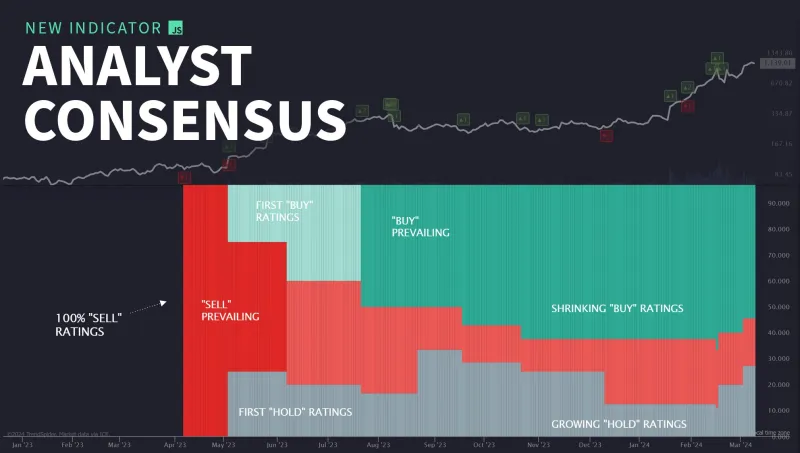
Analyst upgrade concentration is a counterintuitive but useful signal. A cluster of analyst upgrades following a significant price move often marks the end of a trend rather than the beginning of the next leg. Analysts are, by institutional necessity, backward-looking in their revisions. A stock that receives five upgrades after a 60-percent rally has likely already delivered most of its near-term return to those who acted earlier.
A Framework for Entering Trends Without Chasing Them
None of this argues against participating in trends. It argues against entering them at the moment of maximum visibility.
The practical discipline begins with a simple rule: before entering any stock that has materially outperformed its sector over the prior month, require yourself to identify who is still selling and why. Every buyer needs a seller. When a stock is universally praised and retail accumulation is peaking, the sellers are typically the investors who bought earlier and are now distributing into strength. Understanding that you are on the other side of that transaction changes the calculus of the entry.
A structured waiting period — allowing a trending stock to consolidate for at least two to four weeks after a major move before considering entry — filters out a significant percentage of exhausted momentum plays. Consolidation after a trend move is healthy; it represents the market absorbing supply and establishing a new base from which the next leg can develop. Buying into a consolidation is fundamentally different from chasing a vertical move.
Position sizing relative to conviction quality matters equally. When an entry is motivated primarily by the discomfort of watching a stock rise without you, that is not a conviction trade — it is an emotional trade. Sizing it like a conviction trade compounds the error. Smaller initial positions with defined add points on confirming strength preserve both capital and optionality.
The Market's Most Reliable Trap
Markets are not conspiratorial, but they are brutally efficient at separating capital from those who make decisions based on recent performance rather than forward probability. The stocks that feel safest — the ones with the best recent returns, the most media coverage, the broadest analyst support — are frequently the ones carrying the most unrecognized risk.
The investor who learns to recognize the difference between a trend in its early stages and a narrative in its final hours gains an asymmetric edge. Not because they always get the timing right, but because they stop making the systematic error of arriving late and paying full price for a story the market has already told.
At Stoxeri, we believe that trading with conviction requires knowing not just what to buy, but when the evidence supporting a trade is genuine rather than retrospective. The most dangerous moment in any momentum trade is when it feels most obvious. That feeling is the market's invitation — and its trap.