When Everyone Agrees, Nobody Is Right: Profiting from the Collapse of Market Consensus
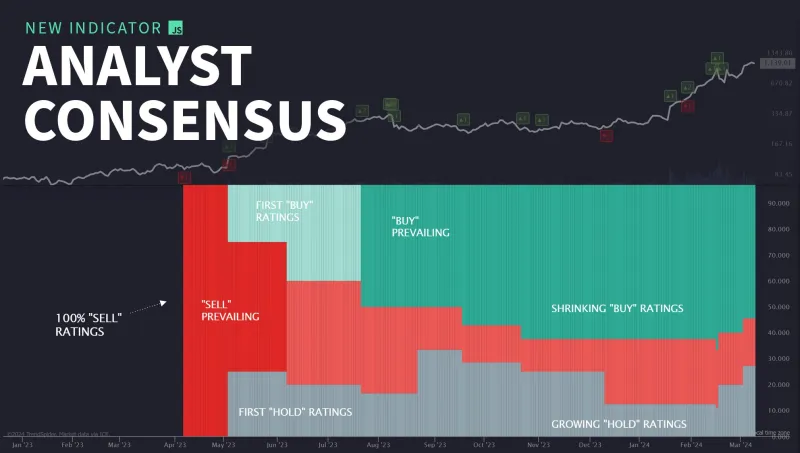
Photo: analysts agreement consensus stock market crowd investing, via trendspider.com
The Paradox of Perfect Agreement
There is a peculiar irony embedded in financial markets: the more confidently the majority agrees on an outcome, the less likely that outcome becomes. This is not a philosophical abstraction. It is a structural feature of how prices are set, how capital flows, and how expectations become embedded in valuations long before the underlying reality has a chance to confirm or deny them.
For investors willing to examine this dynamic honestly, consensus — the condition that most market participants treat as comfort — is often the clearest signal that risk is accumulating unseen.
Why Consensus Estimates Fail
Analyst consensus estimates are a useful reference point. They are not, however, a reliable forecast. Understanding why requires looking at how they are constructed.
Consensus figures are an aggregation of individual analyst models, each of which is influenced by the same publicly available information, the same management guidance, and — critically — the same career incentives. Analysts who diverge dramatically from consensus face professional consequences if they are wrong. The path of least resistance is to cluster near the center of existing estimates, adjusting incrementally rather than reassessing fundamentally.
This produces estimates that reflect the current state of shared belief rather than independent analysis. When a consensus is strong — when the range of estimates is narrow and directional conviction is high — it typically means that a large number of analysts have converged on the same assumptions. What it does not mean is that those assumptions are correct.
The market, meanwhile, prices securities based on expectations. When consensus is widely held and well-publicized, much of that expectation is already embedded in the stock price. A company that meets a strong consensus estimate may see its stock decline, because meeting expectations offers no new information to a market that had already priced the outcome. This is the mechanism behind the familiar frustration of buying a stock ahead of a strong earnings report and watching it fall after the numbers come in exactly as predicted.
Crowded Trades and the Anatomy of Unwinding
Consensus thinking produces crowded trades. When a sufficient proportion of market participants holds the same position based on the same thesis, the trade becomes self-reinforcing on the way up and catastrophically fragile on the way down.
The fragility comes from the exit problem. If a thesis is widely shared, the holders of that trade are, by definition, similar in their behavior. They bought for similar reasons, they monitor for similar signals, and they will sell under similar conditions. When those conditions arrive — a data point that challenges the consensus, a shift in macro environment, or simply a price level that triggers stop-losses across the crowd — the exits are attempted simultaneously by a large portion of the trade's holders.
The resulting unwind is disproportionate to the triggering event. A modest earnings miss on a heavily consensus-owned stock can produce a decline that appears irrational relative to the actual shortfall. It is not irrational — it is the mechanical consequence of crowded positioning meeting a narrow exit.
Identifying the Crowd Before It Moves
Spotting crowded consensus trades before they unwind requires looking beyond price action. Several indicators, used in combination, can identify positions where agreement has reached a level that warrants caution.
Analyst ratings distribution. When the ratio of buy ratings to sell ratings on a widely covered stock exceeds eight or nine to one, it is worth asking who is left to upgrade. Stocks with near-universal buy ratings have exhausted much of their potential institutional sponsorship. The remaining marginal buyers are fewer than the potential sellers.
Short interest as a contrarian signal — in both directions. Very low short interest on a stock with a bullish consensus suggests that even skeptics have been squeezed out or converted. The absence of a short position means there is no natural buying pressure available during a selloff — short-covering, which historically provides a floor during declines, is simply absent.
Institutional ownership concentration. When a stock's shareholder base is dominated by a handful of large institutional holders who share a similar investment style, the correlation of their exit behavior is high. SEC filings, available through EDGAR, allow investors to track ownership concentration across 13-F filings. Meaningful increases in concentration among growth-oriented or momentum-oriented funds, in particular, can signal a trade that has become structurally fragile.
Sentiment surveys and positioning data. The AAII Investor Sentiment Survey, the Commitment of Traders report for futures markets, and various institutional positioning surveys provide direct evidence of crowd behavior. Extremes in these readings — particularly when sustained over multiple periods — have historically preceded reversals.
The Cognitive Trap That Keeps Investors in the Crowd
Knowing that consensus trades are dangerous does not make it easy to avoid them. The psychological pull of agreement is powerful. When a narrative is widely accepted, the evidence supporting it is everywhere. Financial media amplifies the consensus. Peer conversations reinforce it. The stock's price history, which reflects the consensus buying that built the trade, appears to validate the thesis.
This is the availability heuristic operating at a market-wide scale. The ease with which confirming information can be recalled makes the consensus feel more reliable than it is. Challenging it requires deliberate effort and, often, the willingness to appear contrarian in the face of near-universal agreement — a socially and professionally uncomfortable position.
Professional investors who consistently exploit consensus failures are not necessarily smarter than the crowd. They are, however, more disciplined about separating the weight of evidence from the weight of opinion.
Positioning for Divergence Without Becoming a Perma-Bear
Contrarian positioning is not the same as reflexive pessimism. The goal is not to bet against consensus at every opportunity — it is to identify the specific conditions under which consensus is most likely to fail, and to size positions accordingly.
Practically, this means reducing exposure to positions where the consensus is both strong and already embedded in the valuation. It means examining what the stock needs to do to justify its current price, rather than simply accepting that the consensus estimate is achievable. And it means asking, explicitly, what happens to the price if the consensus is wrong by even a modest amount.
For investors willing to take active divergent positions, options markets offer tools to express a view on consensus failure with defined risk. Buying puts on consensus-heavy names ahead of catalysts, or positioning in less-owned names within the same sector, can provide exposure to the divergence without requiring a precise prediction of timing.
The Edge That Doesn't Require a Crystal Ball
The most durable version of this edge is structural rather than predictive. It does not require forecasting exactly when the consensus will break or what the triggering event will be. It requires only the recognition that maximum agreement is a condition of elevated risk — and that portfolios built to exploit divergence, rather than confirm consensus, are positioned to benefit when the inevitable correction arrives.
Markets reward those who think independently. The challenge is that independent thinking is genuinely difficult when the consensus is loud, confident, and, for the moment, correct. The discipline to maintain a differentiated view through that period is what separates investors who profit from consensus failures from those who are caught inside them.